Travelodge has been making the headlines, but for the wrong reasons - could you be next?

Every major reputational crisis has a "before" and an "after." The after is well documented: the headline, the apology, the regulator's letter, the independent review, and now, in Travelodge's case, the boss's resignation. The before is where most organisations miss their shot, because the signals were often already there, scattered across complaints, reviews and social posts, just never connected.
Travelodge's recent crisis is a sobering example of what happens when they aren't.
The Story that Kept Growing
In December 2022, a man at a Travelodge in Maidenhead lied to reception staff, claiming to be the boyfriend of a woman staying there, and was handed a key card to her room. He assaulted her while she slept. He was sentenced in early 2026 to more than seven years in prison, and that conviction is where the public story really started.
What followed says more about organisational readiness than the original failure did. The victim told the BBC that Travelodge had been slow to respond and hadn't seemed to take her case seriously. She was initially offered a £30 refund, which she called "insulting." Once the case became national news, other guests came forward with their own experiences, including one traveller who said he'd twice been caught up in key-card mix-ups at Travelodge properties - in one case opening his door to find someone already inside.
More than 100 MPs signed a letter demanding a meeting with chief executive Jo Boydell, and the case was even raised at Prime Minister's Questions, with Sir Keir Starmer saying he was "very concerned" after Boydell initially cancelled that meeting.
What's uncovered is a pattern of similar, lower-severity issues and dismissive complaint handling that existed in parallel and appeared unconnected, until a court case, which ultimately cost the chief executive her job.
The real detection failure
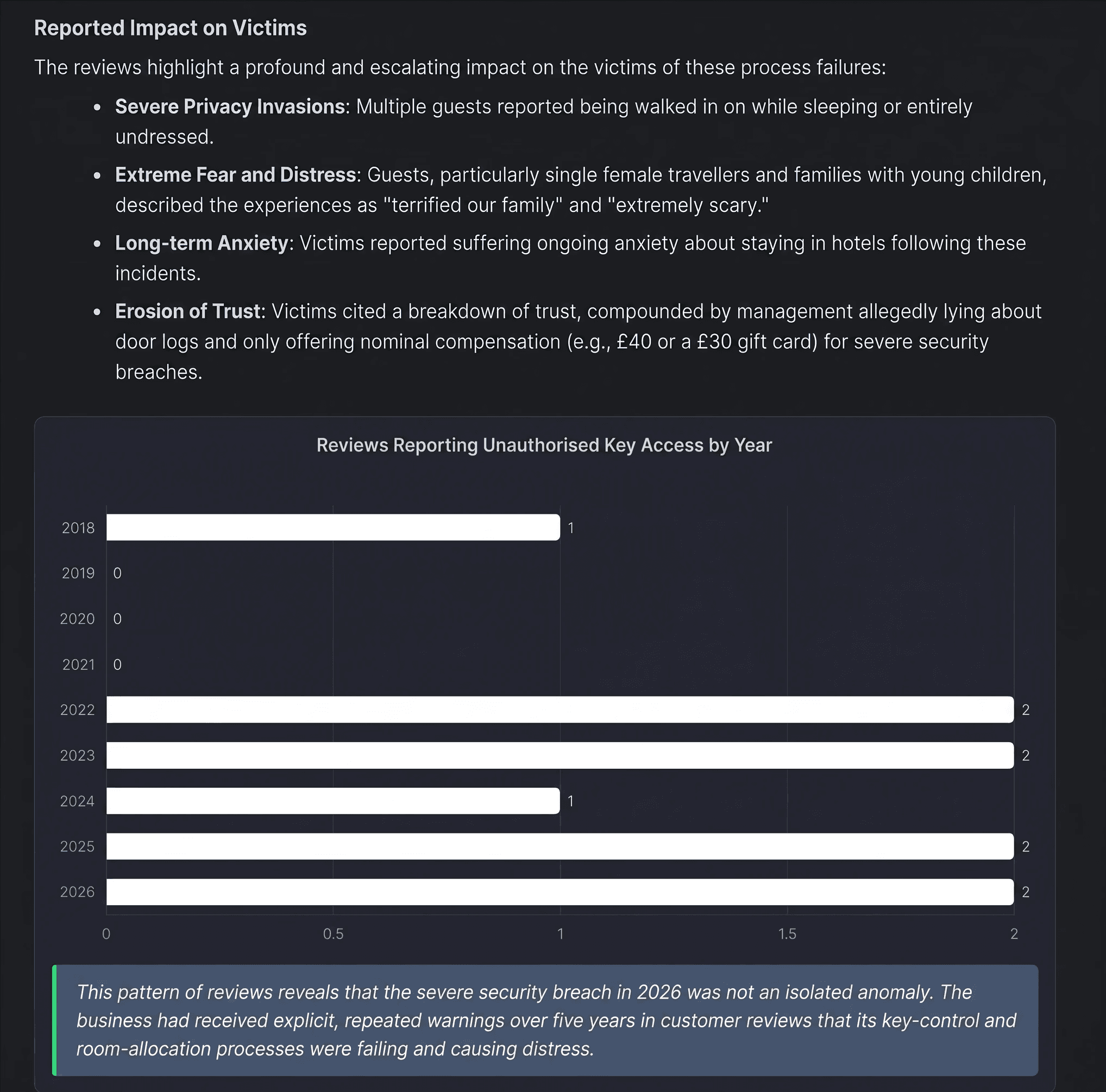
Using CourtCorrect's analytics platform, our teams investigated publicly available social media, review and feedback data and identified cases of unauthorised room access dating back as far as June 2018! Since then, there have been multiple further instances of unauthorised entry into rooms already occupied by customers. This pattern of repeated incidents points to a key deficiency in Travelodge's complaints and reporting systems, where the signals were there, but no action was taken, until it cost a woman her safety twice over and cost a CEO her role.
This is precisely the risk our analytics platform is built to catch. It lets users assess large public datasets at the click of a button, surfacing issues and pointing toward solutions before they repeat and escalate into something more serious.
Users on the CourtCorrect platform can produce reports drawing on years of publicly available data across social media, review sites and other third-party sources. Models are fully customisable where users can prompt them with their own questions and areas of focus to uncover insights and trends that carry the greatest risk and matter the most to their business. In Travelodge's case, our platform identified 10 unique instances of unauthorised entry since June 2018, shown below with a breakdown of the impact on each customer, described in their own words.
This is the pattern that matters for any regulated or customer-facing business: the individual signals rarely go missing, and are often publicly available. A complaint here, a one-star review there, a comment on social media, a pattern an MP or journalist eventually stitches together.
A question to ask yourself - how often do comments or reviews go unnoticed, especially those with wider implications than initially stated? By the time a journalist, MP or regulator does that stitching for you, the story is no longer yours to shape and you find yourself reacting to a narrative instead of demonstrating that you already knew, and were already acting.
The question every leadership team should be asking
What's sitting in your own data right now, across complaints, reviews, social channels, that could become the story a regulator or a news network tells about you in six to twelve months?
The companies best placed to answer that aren't the ones with zero issues - no-one has zero issues. They're the ones who can see recurring themes early enough to intervene, fix the underlying process, and, if the moment comes, show a journalist or regulator that they'd already found the problem and acted on it, rather than being told about it.
Connecting the signals before someone else does
This is the gap CourtCorrect's Analytics Platform is helping clients to close: pulling together internal complaints data, social media, review platforms, and other relevant external sources, to surface recurring themes and emerging risks before they compound into something much harder to contain.
Our aim is to help organisations focus on delivering the highest quality of customer care, while having complete oversight over their business, no matter the size and scale.
A single complaint rarely tells the full story, however, a pattern across dozens of them, spotted early, usually does.