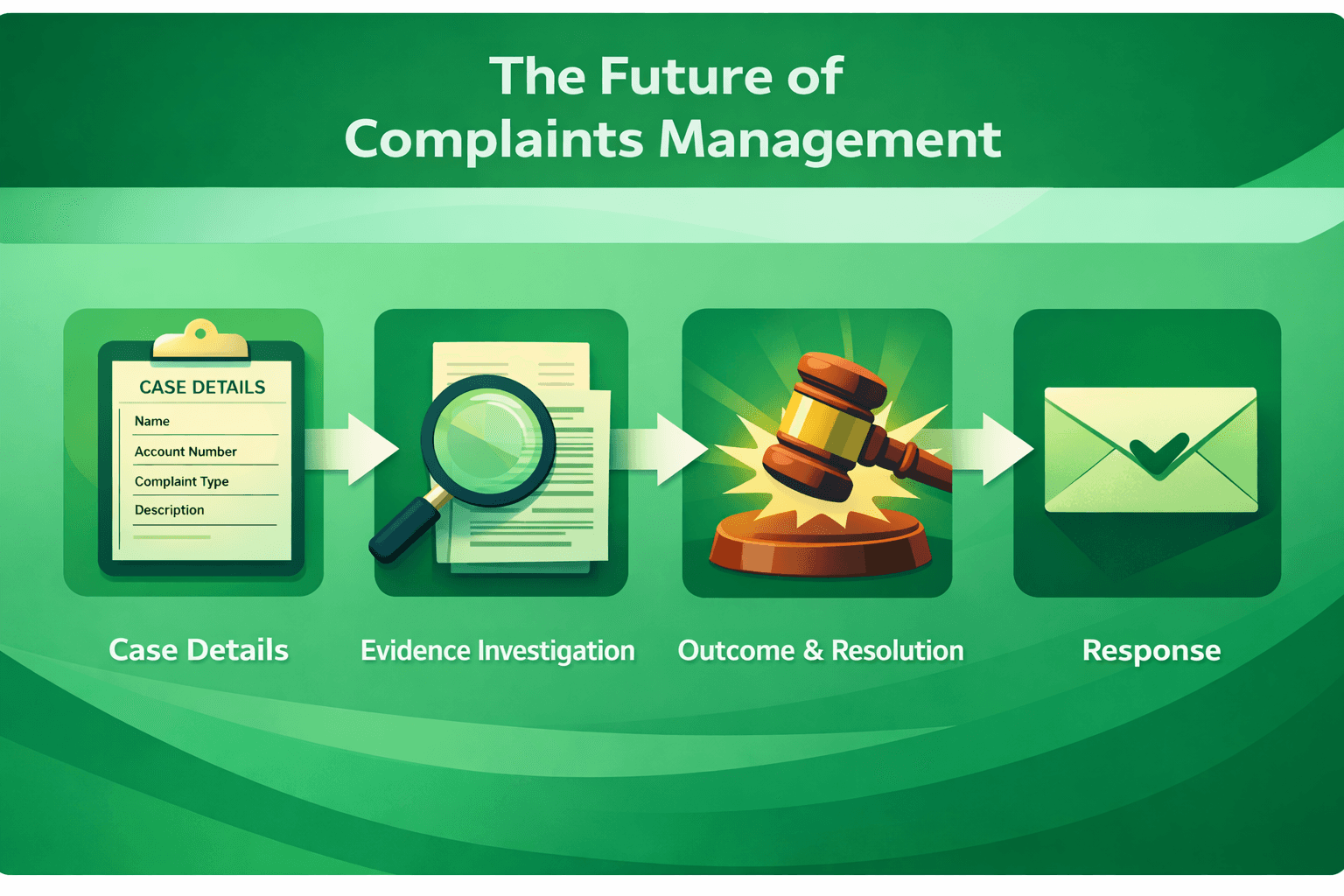
Traditional complaints handling is built around manual handovers. A complaint is received, information is gathered, evidence is reviewed, an outcome is reached and a response is drafted, but each part of that journey is often handled separately. The result is a process that can be slow, manual and difficult to run consistently.
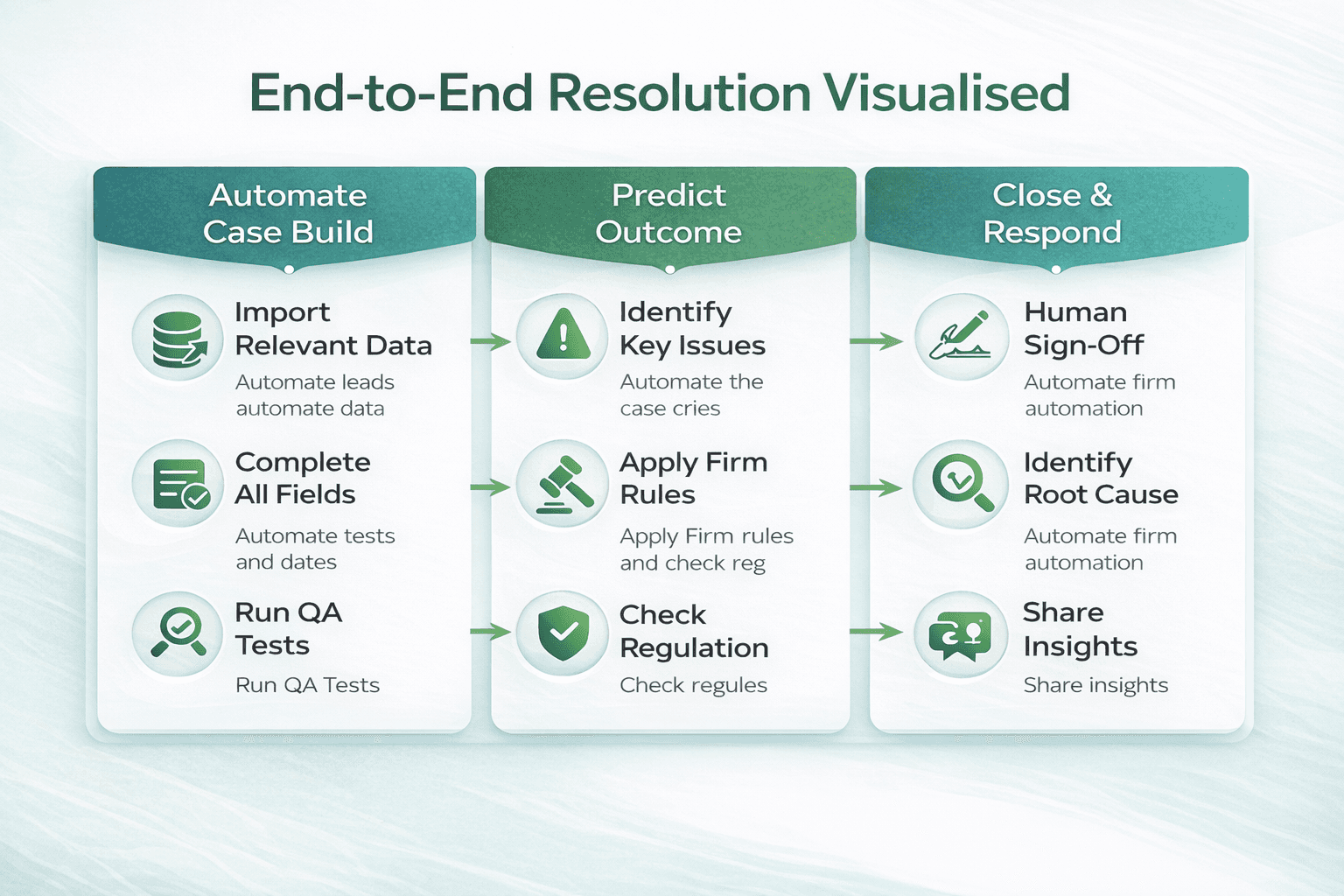
CourtCorrect’s End-to-End Resolution capability is designed to change that. Using AI to support and enhance each stage of the complaints journey, it allows for the instantaneous completion of all steps in the resolution process from the point a complaint is received through to a draft final response letter ready for handler review. Rather than asking teams to move a case manually from one stage to the next, AI pre-builds the entire case file ready for human review, with each stage building on the last.
The result: the ability to pre-solve up to 70% of inbound complaints volume the moment the case is received, leading to a 90%+ efficiency gain on these cases.
In this post, we consider what End-to-End resolution is, how it works and how it benefits firms in regulated industries, especially those with high volumes of complaints.
Fragmentation to consolidation
A complaint might arrive through an inbox or an intake form, but the information needed to resolve it is usually spread across several different systems. Handlers often have to pull together emails, calls, documents and internal notes before they can properly assess what happened. In most teams, that remains one of the slowest parts of the process.
As a complaint enters the platform, the relevant information can be drawn together from across internal systems rather than gathered manually before the real review has even begun. What would normally sit across multiple records, channels and documents can instead be brought into one case file at the start of the journey, giving the next stage a much stronger foundation.
Building the case
Using a unique identifier, CourtCorrect AI can pull the relevant information from internal systems and populate the case details automatically, helping ensure that the core facts of the complaint are captured from the outset.
This stage is not just about collecting information. It is about turning that information into a usable case record. As the file is built, the AI organises the material into a clear structure, making the case easier to review and work through. It can also flag anything that may affect how the complaint should be handled, including potential vulnerability, which in some cases may be explicit. In some cases, this will be explicit. In others, it may only appear through the wording of an email, the tone of an interaction or the wider context around the complaint. Identifying that as the case is built helps ensure the investigation proceeds with the right level of care and oversight for that complaint.
Investigating the evidence
With the case file built, the next stage is evidence investigation. Here, CourtCorrect AI works through the material that has been pulled into the file and examines it in light of the complaint to understand what the evidence shows, what sections of the evidence are relevant to the case and what are all the complaint issues.
CourtCorrect AI will review correspondence, calls, documents and notes together, identify the key complaint points raised by the customer and produce an assessed summary of the case based on the evidence available. By the end of this stage, the case has moved beyond a bundle of information and become a defined dispute with clear issues to be determined. That gives the outcome stage something much firmer to work from.
Reaching an outcome
Once the complaint issues have been identified, the next step is to assess them against the standards the firm's internal framework. This is where CourtCorrect AI considers those issues in light of the client’s internal policies, the relevant regulatory materials and the broader decision-making patterns reflected in FOS analytics and previous FOS outcomes.
This is the stage where evidence turns into resolution logic. The question is no longer just what happened, but what should follow from it. Should the complaint be upheld in full, upheld in part or rejected. Is compensation likely to be appropriate, and if so on what basis. How does the case sit against a company’s own internal guidance and the wider expectations that could shape the complaint outcome.
Drafting the response
Once an outcome has been reached, the final stage is to turn that reasoning into friendly, concise and constructive response to the customer. CourtCorrect AI drafts the final response letter using the findings from the earlier stages, setting out the complaint, the relevant facts, the outcome reached and the reasoning behind it in a form ready for handler approval. Each response can be generated in the client’s own tone and style, so the response is aligned with the way the firm communicates with customers.
Handlers can then review the draft, make any changes they need and use readability scoring and AI editing tools to refine the letter further before it is issued. The aim is not to remove human judgement from the response stage, but to make that judgement easier to apply by giving handlers a well-structured letter that is already built around the case and ready to be approved.
Exception handling
No complaints process should assume that every case ought to follow exactly the same route. Some complaints will need earlier human involvement because the facts are unclear, the circumstances are sensitive or the case calls for a more careful exercise of judgement than a standard workflow should provide.
That is why End-to-End Resolution is best understood as a flexible model rather than an all-or-nothing approach. A case might be handed over after the file has been built, after the evidence has been reviewed or after an outcome has been formed, depending on where the greatest value lies. The aim is not to force every complaint through the full journey unchanged, but to use AI where it strengthens the process most and hand over where a more human touch is needed.
Identifying Root Causes at Scale
Root cause analysis often begins too late. By the time patterns are clear enough to act on, the same issue may already have affected far more customers than it should have done. What should be a way of identifying systemic weaknesses early can end up becoming a retrospective exercise carried out after the damage is already visible.
When complaints move through one connected workflow, that starts to change. Issues are identified more consistently, outcomes are easier to track and the data generated by the process becomes far more useful at an aggregate level. Instead of relying on a partial or delayed view, firms are in a stronger position to understand what is driving repeat complaints and where friction is building across the wider customer journey.
CourtCorrect’s data dashboard enables firms to monitor complaint trends as they develop, track recurring drivers and see whether remedial actions are having the intended effect. The result is a shift away from reactive correction and towards earlier, more informed intervention, where complaints data can be used not only to resolve individual cases but also to address the upstream issues behind them.
About CourtCorrect
CourtCorrect is an AI startup based in London, focusing on the safe deployment of artificial intelligence for complaints resolution and operational resilience in regulated sectors. We partner primarily with financial services firms to deploy AI tools to address specific pain points in their customer journeys and improve outcomes for their customers.
To learn more about CourtCorrect and our AI Complaints Management Platform please find a link to our contact page here. You can also schedule a demo here, or get in touch with our team by emailing henry@courtcorrect.com.